Culture FAQs
How did your tribe come up with its name?
The name by which we call ourselves is Lenape [pronounced as if spelled “lun-NAH-pay”], and this name means something like “The People.” It is common for many groups of people around the world to use a name that has a similar translation. We do not know how long that name has been in use, but related tribes use similar words, so we think it has been in use for many hundreds of years.
Why did the Lenape people accept the name delaware?
It has long been known that the name applied to the Native people who lived along the Delaware River was taken from the title of an Englishman, Lord de la Warr, whose name was Sir Thomas West. He was appointed governor of the English colony at Jamestown, Virginia in 1610. One of his followers, Captain Samuel Argall, once sailed into a majestic bay which he named “de la Warr Bay” in honor of the governor. The river that flowed into the bay was given the same name, and they both were later contracted into Delaware.
People have asked why the Lenape people seem to have no problem with accepting this “foreign” name for themselves. The reason is that the Lenape have their own story about the origin of the name “Delaware.” It is as follows:
The Lenape story is that when the Europeans first arrived a whiteman kept trying to ask a Lenape what tribe he belonged to, and he told him “Lenape.” For some reason the whiteman had trouble saying the word properly, and would say “Lenuhpee,” “Renahpay” and other mispronunciations. Finally he said “Lenape” correctly, and the Lenape said, “Nal në ndëluwèn! Nal në ndëluwèn!” (That’s what I said! That’s what I said!).
The whiteman heard the DULUWEN part and he said, “Oh, you said Delaware! So you are a Delaware. Now I know what to call you,” and the name stuck.
The Delawares have used the name ever since that time because they knew that the whites just could not say Lenape properly. Of course, when speaking to each other, Lenape people call themselves “Lenape.”
How did The Europeans ask or force your ancestors to move west?
Our ancestors were asked to sign treaties giving up the land, but they had no idea that they were actually selling land any more than you would think someone could sell air. The belief was that all land was put here by the Creator for use by his children, and that you should not be stingy with it. The Lenape of those days thought they were granting the Europeans the use of the land for a while. They in turn received gifts for the use of the land, like rent. Only later did they come to understand the European concept of private land ownership. Sometimes also our people were tricked out of their land. A great deal of their land in eastern Pennsylvania was taken by trickery. The Lenape were told that their ancestors many years before had signed a treaty giving up as much land as could be walked in a day and a half. Since they couldn’t read they had no way of knowing they were being fooled, and they agreed to the walk. But instead of walking the whites ran, and got a huge piece of land. This was called the “Walking Purchase”.
What are some of the celebrations of your people?
We hold a number of what we call Stomp Dances throughout the year. These are social dances done just for the enjoyment of dancing. Time is kept on what is called a water-drum. Sometimes in conjunction with these dances we play Pahsahëman, which is the Lenape football game. It is played differently from the football game you know because it is played men against women. The men can only kick the ball from place to place, but the women can throw it or run with it. Also the men are not supposed to tackle or grab the women, but the women can do whatever they want. There are goalposts at either end of the field similar to regular football, although they have no crosspiece. Many of us also attend pow-wows, which are dances at which you wear the traditional Indian clothing and dance to the sound of a large drum accompanied by singers.
Was The Mësingw on the Tribal Seal considered a god?
First of all, he was not a god. The Lenape believe in one God only, but under him there are manëtuwàk, and these are “lesser spirits,” and they have various roles to fill. I am not sure they would be the same as the whiteman’s angels, but perhaps somewhat similar.
The Mësingw was the guardian spirit of the game animals, such as deer and bear, etc. It was said he “helped” the Lenape find game when they went hunting, and also that he would sometimes be seen riding on the back of a deer.
The Mësingw had a face that was half red and half black, like the one on the seal, and the man who impersonated him at certain ceremonies wore a suit made of bearskin.
Because he had a fearful appearance, the parents would sometimes use the mention of him to correct the children. They were told that the Mësingw would get them if they didn’t behave.
When your ancestors were forced from their homeland, did you lose any part of your traditions?
We have lost a number of things on our forced trek west to Oklahoma. Many of our old traditional ways included making things, such as clay pots to cook and store food in; flint knapping to make arrowheads and flint knives; and decorating things with dyed porcupine quills. We also lost knowledge of sea creatures that we would have known on the east coast, and some of our songs and dances. But we have also been able to preserve many things also.
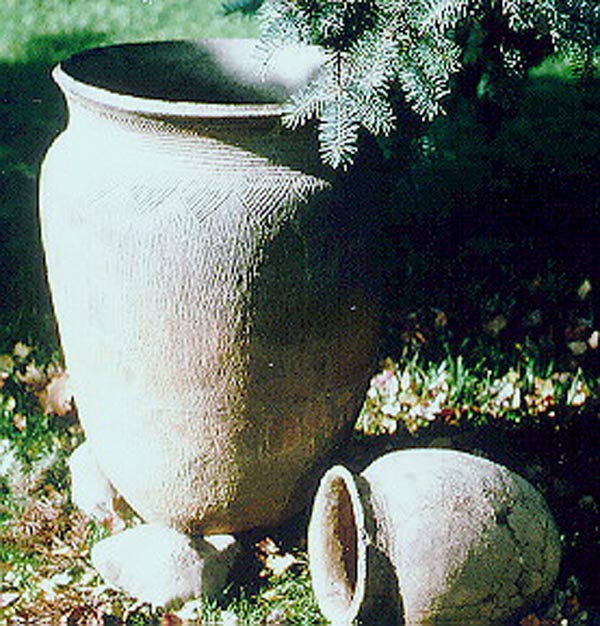
The Lenape made cooking pots and other vessels out of clay. In this photograph the small pot on its side is the normal size cooking vessel. The large pot holds about twenty gallons and may have been used for some type of ceremonial event. Photograph courtesy of Herbert C. Kraft
Why are there two groups (bands) of Delawares in Oklahoma?
There are two bands of Delawares here in Oklahoma because the western group (now centered at Anadarko, Oklahoma) split off from our group about 215 years ago when we were all in Indiana. They headed down thru Louisiana into Texas, and finally got pushed out of there into western Oklahoma.
After leaving Indiana our group went to Kansas and we lived there for thirty years until we were forced to move into Indian Territory (now Oklahoma). Our group with headquarters in Bartlesville, Oklahoma, is the main group and we now number 10,500.